
AI-Powered Accessibility: Evaluating the Role of Machine Learning in Inclusive User Interface Design
A study evaluating how machine learning can support more inclusive user interface design, with a user study measuring task time, success rate and perceived readability.
Research overview
AI-Powered Accessibility: Evaluating the Role of Machine Learning in Inclusive User Interface Design
A study exploring how machine learning can support more inclusive user interfaces, using a 52-participant study to measure task completion time, task success and perceived readability.
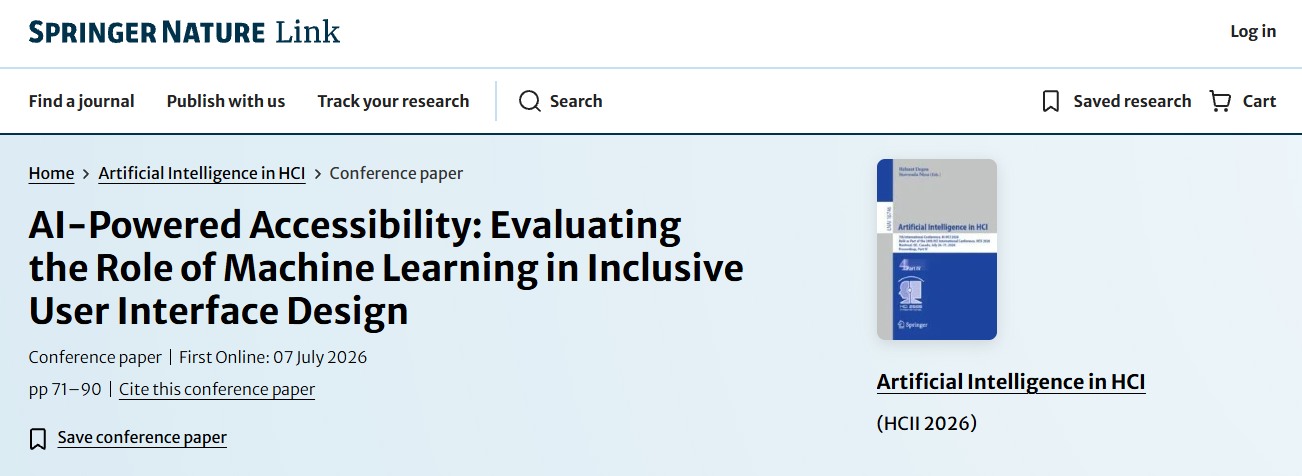
Published by
Springer, Lecture Notes in Computer Science
First and corresponding author
Authors: Danish Khan, Irfan Ahmed and Iman Muhammad Asif
Research overview
Accessibility is often treated as a checklist of technical requirements. I wanted to look at a different question: can an interface actively adapt in ways that make it easier for people to use?
As first and corresponding author, I worked on a machine-learning-based approach to inclusive user interface design. The study focused on whether adaptive changes could produce measurable improvements in how people interacted with an interface.
The system was evaluated with 52 participants, looking at task completion time, task success and perceived readability.
- 25.6% reduction in task completion time
- Task success increased from 68.3% to 82.7%
- 78% of participants reported improved readability
- 35% wanted greater control over the adjustments
These results showed both sides of adaptive design. Automation can make an interface easier to use, but users may still want control over how those changes are applied.
What I learned from the research
The most useful outcome was not simply that machine learning improved the measured results.
It was the balance between automation and user control.
The system improved task performance and readability for many participants, but the feedback from those wanting more control showed that an adaptive interface should not make every decision on behalf of the user.
AI can help remove accessibility barriers, but inclusive design still needs to respect user choice.
Good adaptive systems should assist people, not take control away from them.
Conference presentation and publication
The paper was accepted for presentation at HCI International 2026, the 28th International Conference on Human-Computer Interaction.
I presented the research remotely on 28 July 2026 to an international HCI audience.
Springer published the paper in Lecture Notes in Computer Science on 7 July 2026.
Connected work
Explore the bigger picture.
Keep exploring
Continue exploring the research.
Read more about accessibility, inclusive interfaces and the tools that support them.