
AI-Enhanced Color Contrast Checker for WCAG Oriented Real-Time Accessibility Evaluation
Peer-reviewed IEEE research on AI-supported, WCAG-oriented real-time colour contrast evaluation.
Research overview
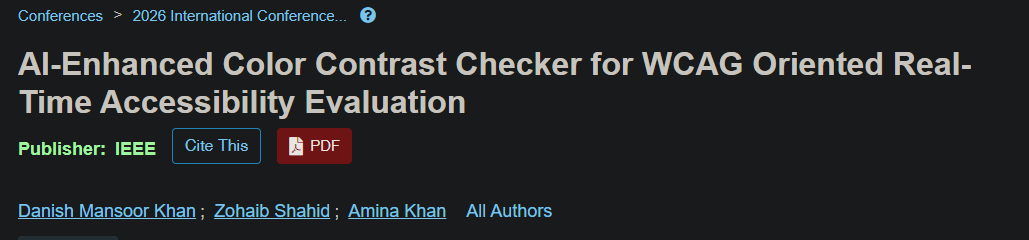
This paper grew from the same accessibility problem that later became the A11y Smart Color Contrast Checker: many colour-contrast tools can identify when a colour combination fails WCAG requirements, but they do not necessarily help designers find a suitable alternative.
As first author, I explored a different approach: combining real-time WCAG contrast evaluation with machine learning to recommend accessible colour alternatives while retaining important characteristics of the original colour.
From detecting a problem to helping fix it
The aim was not simply to tell a designer that a colour combination had failed. I wanted the system to help with the next decision too.
The proposed approach evaluates colour contrast and generates alternatives that meet accessibility requirements while staying visually connected to the original palette. This makes accessibility part of the design decision rather than only presenting a pass-or-fail result.
One of the technical challenges was balancing three things at the same time: accessibility, visual relevance and response speed.
- In one evaluated case, the contrast ratio improved from 2.82 to 8.08
- The recommended colour retained the intended characteristics of the original brand colour
- Client-side AI inference operated in under 200 milliseconds
For me, this was an important part of the research because an accessibility solution needs to be technically correct, but it also needs to be practical enough to fit into a designer's workflow.
From research to a working product
The research did not remain only as an academic proposal. The underlying idea was developed into the open-source A11y Smart Color Contrast Checker, available as both a web application and a Figma plugin.
This connection between research and product development allowed me to take the same accessibility problem from investigation and experimentation into a tool that designers could use in their normal workflow.
Peer review and publication
The paper, “AI-Enhanced Color Contrast Checker for WCAG Oriented Real-Time Accessibility Evaluation”, was accepted by the International Conference on AI Innovations and Industry (ICAIII 2026) on 11 March 2026.
I presented the research remotely on 6 April 2026, and it was subsequently published in IEEE Xplore on 22 May 2026.
Read the publication on IEEE Xplore
What I learned from the research
The main lesson for me was that an accessibility checker becomes much more useful when it helps with the decision that comes after detecting a problem.
Accessibility and brand consistency do not have to be treated as opposing goals. A better tool can help designers work towards both.
That idea continues to shape how I approach accessibility product design: identify the barrier, give the user a practical way to resolve it, and keep the solution close to the workflow where the problem occurs.
Connected work
Explore the bigger picture.
Keep exploring
Continue exploring the research.
Read more about accessibility, inclusive interfaces and the tools that support them.